
Carbon Fiber + MoS₂ Filled PTFE Gasket
order Carbon Fiber + MoS₂ Filled PTFE GasketContact Us:+98 21 8817 5113
For pricing and order placement, please provide the flange dimensions, process media, operating temperature and pressure. Our technical team will recommend the optimal size, thickness and grade of Carbon Fiber + MoS₂ Filled PTFE Gasket for your application. Custom and standard dimensions are available upon request.
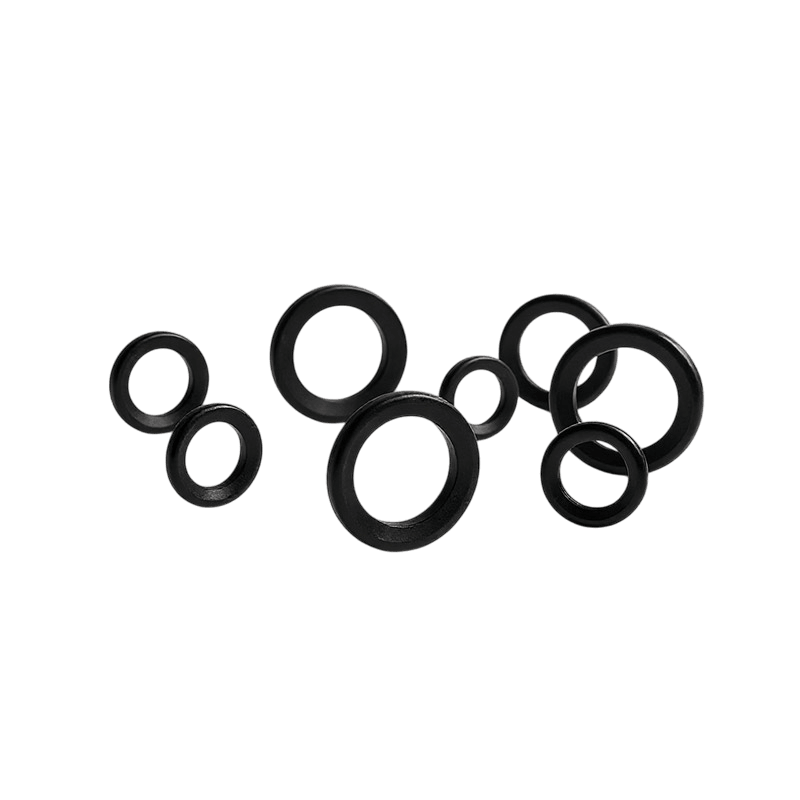
Carbon Fiber + MoS₂ Filled PTFE Gasket | Engineered for Extreme Wear, Pressure & Dynamic Loads
A Carbon Fiber + MoS₂ Filled PTFE Gasket is an advanced tribological composite engineered for applications where high pressure, severe wear, and continuous dynamic motion occur simultaneously. In this grade, the PTFE matrix is reinforced with carbon fibers for structural strength and dimensional stability, while Molybdenum Disulfide (MoS₂) acts as a solid lubricant that significantly reduces friction and suppresses localized heating.
This combination delivers a gasket with exceptional resistance to wear, creep, and mechanical loading, making it a high-reliability choice for critical sealing points in demanding industrial systems.
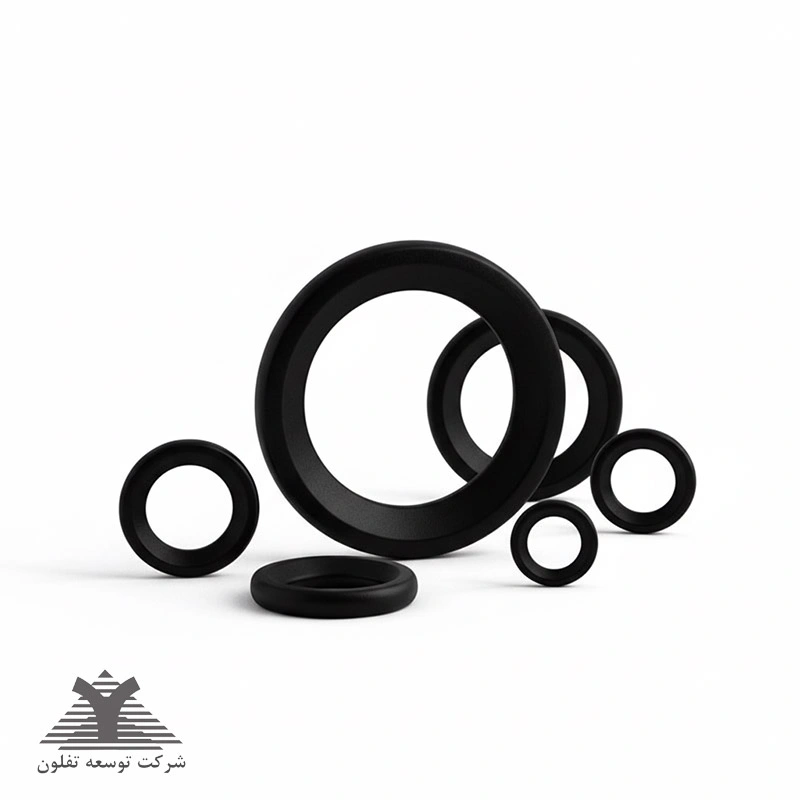
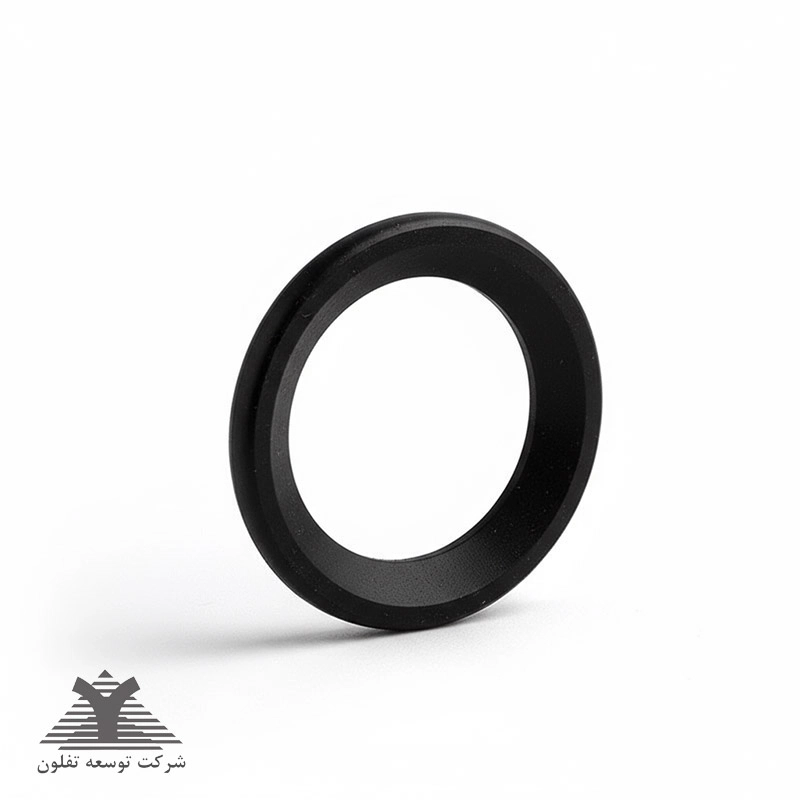
In operating environments that involve relative motion between surfaces, vibration, frequent start-up/shut-down cycles, and elevated system pressure, Carbon Fiber + MoS₂ PTFE gaskets maintain long-term sealing integrity far better than conventional PTFE grades.
This grade is widely used in high-pressure hydraulic systems, rotating equipment, sliding bearings, dynamic flange joints, and critical points in oil, gas, and petrochemical units—where gasket selection has a direct impact on uptime, equipment life, and leak-prevention performance.
Technical Specifications & Key Properties of Carbon Fiber + MoS₂ Filled PTFE Gaskets
- This grade is formulated from a PTFE matrix reinforced with carbon fibers and enhanced with Molybdenum Disulfide (MoS₂) as a solid lubricant.
- Carbon fibers act as the primary structural reinforcement, significantly increasing stiffness and mechanical strength compared to Virgin PTFE.
- The addition of MoS₂ provides a controlled-friction surface and stable tribological behavior under sliding, vibration, and dynamic loading.
- Engineered for service in high-pressure applications with continuous mechanical loading across flanges and dynamic sealing points.
- Exhibits substantially lower creep and deformation over time compared to standard PTFE gasket grades.
- The composite PTFE + Carbon Fiber + MoS₂ structure makes it suitable for dynamic and semi-dynamic environments where vibration and wear are dominant factors.
- Designed for high-performance sealing in heavy-duty hydraulic systems, rotating machinery, and critical process equipment.
- Allows precision machining and fabrication in standard or fully custom dimensions with tight engineering tolerances.
- More resistant to extrusion, edge deformation, and localized crushing under high bolt torque compared to softer PTFE variants.
- A preferred specialty option for sealing systems requiring long service life, high wear resistance, and mechanical robustness under combined stress conditions.
Advantages & Limitations of Carbon Fiber + MoS₂ Filled PTFE Gaskets in Heavy-Duty and High-Pressure Service
The Carbon Fiber + MoS₂ Filled PTFE gasket is a highly specialized composite grade and is not intended for broad, general-purpose use across an entire plant. It is selected primarily for critical sealing points where high pressure, severe wear, and dynamic loading occur simultaneously. Understanding its strengths and constraints helps determine when the investment is justified and when a simpler grade is sufficient.
Advantages – Why Engineers Choose Carbon Fiber + MoS₂ Filled PTFE Gaskets
Limitations – When Carbon Fiber + MoS₂ Filled PTFE Is Not the Ideal Choice
For projects with a limited number of critical points and constrained budgets, more economical reinforced PTFE grades (e.g., Carbon-Filled or Bronze-Filled PTFE) may offer a more balanced cost-performance ratio.
Comparison of Carbon Fiber + MoS₂ Filled PTFE with Other PTFE Gasket Grades in Dynamic Service
Carbon Fiber + MoS₂ Filled PTFE is engineered for applications where high pressure, severe wear, and continuous vibration or relative motion occur simultaneously. To better understand this grade’s true position within the broader PTFE family, the following comparison focuses on service type (static vs. dynamic), wear severity, shutdown sensitivity, and maintenance complexity—not just theoretical material properties.
| Gasket Grade | Service Type (Primary Mode of Operation) | Acceptable Wear Level | Behavior Under Vibration and Relative Motion | Typical Shutdown Sensitivity | Maintenance & Replacement Complexity | Typical Equipment Examples |
|---|---|---|---|---|---|---|
| Virgin PTFE Gasket | Static service with primary focus on chemical inertness and purity | Low; unsuitable for any significant abrasion or sliding contact | Low vibration tolerance; not designed for dynamic or semi-dynamic sealing | Moderate; more sensitive to chemical attack and compatibility than to mechanical cycling | Straightforward replacement; may require more frequent retightening or inspection under load | Static flanges in chemical-process lines, sanitary systems, and high-purity applications |
| 25% Glass-Filled PTFE Gasket | Static service under steady, continuous pressure | Moderate; optimized for sustaining static load rather than abrasion | Tolerates limited vibration; not intended for significant dynamic or reciprocating movement | Low-to-moderate; primary concern is long-term creep under sustained compressive load | Scheduled, predictable replacement cycles with stable behavior over time | Static flanges in general chemical-process lines and industrial service |
| 25% Carbon-Filled PTFE Gasket | Semi-static service with moderate pressure and minor vibration | Moderate to moderately high under typical industrial conditions | Performs well under limited vibration and minor relative movement | Moderate; suitable for a broad range of general-purpose process locations | Relatively simple; well-suited as a standard stock grade for routine use | Process piping, general chemical-service flanges, industrial hydraulic systems |
| 40% Bronze-Filled PTFE Gasket | Static and semi-dynamic service under high pressure | High; suitable for limited-contact wear in pressure-intense environments | Resistant to moderate vibration, but not designed for continuous dynamic movement | High; typically used in locations where leakage risk is unacceptable | Requires planned maintenance with controlled torque application | High-pressure flanges in oil & gas, petrochemical units, and heavy hydraulic systems |
| Bronze + MoS₂ Filled PTFE Gasket (Bronze–Molybdenum Disulfide Composite) | Severe-duty service with high pressure and significant wear | Very high; engineered for intense abrasive and tribological contact | Highly stable under severe vibration and continuous relative motion | Very high; typically selected for fully critical sealing points | More specialized maintenance with extended service intervals | High-pressure hydraulic systems, rotating equipment, specialty dynamic flanges |
| Carbon Fiber + MoS₂ Filled PTFE Gasket (This Product) | Dynamic and semi-dynamic service with high wear and vibration | Very high; engineered for continuous sliding contact and sustained abrasive loads | Exceptional stability under vibration, sliding movement, and frequent start-stop cycles | Very high; typically selected for locations where gasket failure could cause major operational downtime | Scheduled maintenance with focus on extending service intervals | Rotating equipment, dynamic flanges, high-pressure systems exposed to severe wear and vibration |
Specialized Applications of Carbon Fiber + MoS₂ Filled PTFE Gaskets in Dynamic Service
Carbon Fiber + MoS₂ Filled PTFE gaskets are engineered for service locations where high pressure, continuous wear, vibration, and relative motion occur simultaneously. The list below highlights the key industrial applications where this grade delivers the strongest technical and economic value—particularly at critical sealing points where stability under dynamic loads is essential.
Rotating Equipment and Sliding Shafts
Ideal for sealing points in pumps, shafts, and rotating equipment where continuous relative motion and abrasive wear are present.
High-Pressure Hydraulic Systems with Significant Vibration
Used in manifolds and hydraulic connections operating under high pressure, pressure pulsations, and sustained vibration.
Dynamic Flanges and Process-Line Connections
Suitable for flange joints in process circuits where, aside from pressure, relative motion, shock loading, and variable mechanical loads occur.
Sliding Bearings and Wear-Intensive Supports
Applied at contact surfaces subjected to continuous friction, where controlled sealing and smooth motion must be maintained simultaneously.
Test Rigs, Calibration Units, and Frequent Start/Stop Cycles
Designed for equipment exposed to repeated on/off cycles, where the gasket must retain sealing integrity without creep or performance degradation.
Critical Points in Oil, Gas & Energy Systems with Severe Wear and Vibration
A specialized choice for high-risk sealing points where failure could lead to unplanned shutdowns, safety hazards, or significant operational losses.
Frequently Asked Questions About Carbon Fiber– and MoS₂–Reinforced PTFE Gaskets
This gasket grade is engineered for applications where high pressure, continuous abrasive wear, vibration, and relative motion occur simultaneously.
If your sealing point operates in a purely static condition, such an advanced composite is usually unnecessary.
However, in pumps, rotating equipment, high-pressure hydraulic circuits, dynamic flanges, and assemblies exposed to mechanical cycling, a Carbon Fiber + MoS₂ filled PTFE gasket offers significantly enhanced sealing stability compared to conventional PTFE grades.
Carbon-filled and bronze-filled PTFE grades are primarily optimized for compressive strength and load-bearing capacity, whereas the Carbon Fiber + MoS₂ composite is specifically designed to withstand dynamic friction, sliding contact, and vibration.
Carbon fibers provide structural reinforcement, while molybdenum disulfide (MoS₂) acts as a solid lubricant that reduces friction and heat generation.
As a result, in applications where sliding motion, vibration, and repeated start/stop cycles are present, this composite delivers superior dimensional stability, wear resistance, and service life compared to bronze-filled or standard carbon-filled PTFE.
This composite retains much of PTFE’s desirable chemical resistance, but because it contains carbon fibers and tribological additives, it is not universally recommended for all environments.
It performs very well in many industrial fluids, oils, and hydraulic media, but for:
high-purity applications,
ultra-corrosive chemical environments, or
sanitary processes with stringent contamination limits,
other PTFE grades—especially unfilled PTFE—may be more appropriate.
A detailed review of fluid compatibility, temperature, and pressure should be performed before final selection.

